Saturday, September 21, 2019

Stories, Anecdotes and Reflections - Part one of the journey


In just a few days I’ll be heading back to Thailand for part two of the rice growing venture.  I can’t wait to get back to see what the rice is doing (growing hopefully!) It’s been a busy two months back in the US with clients and work (including the week in Kabul.) There are still stories and anecdotes I have wanted to share about the first two months in Thailand (some rice growing related, most not) so this is my attempt at capturing a little more of the journey in writing – for myself and for those who are interested.

Pa Tyng
Waiting – The first month was more waiting than I anticipated. I didn’t mind, it gave me time to watch the mountains, something I didn’t pay much attention to growing up but whenever I return as an adult, I am quite transfixed by the rugged mountain ranges that cover this part of the world that I love so much. I’m not sure I ever fully relaxed and exhaled during my two months in Thailand (which was surprising to me) but the net effect of time and a very different pace of life did start to rejuvenate and restore me a little.


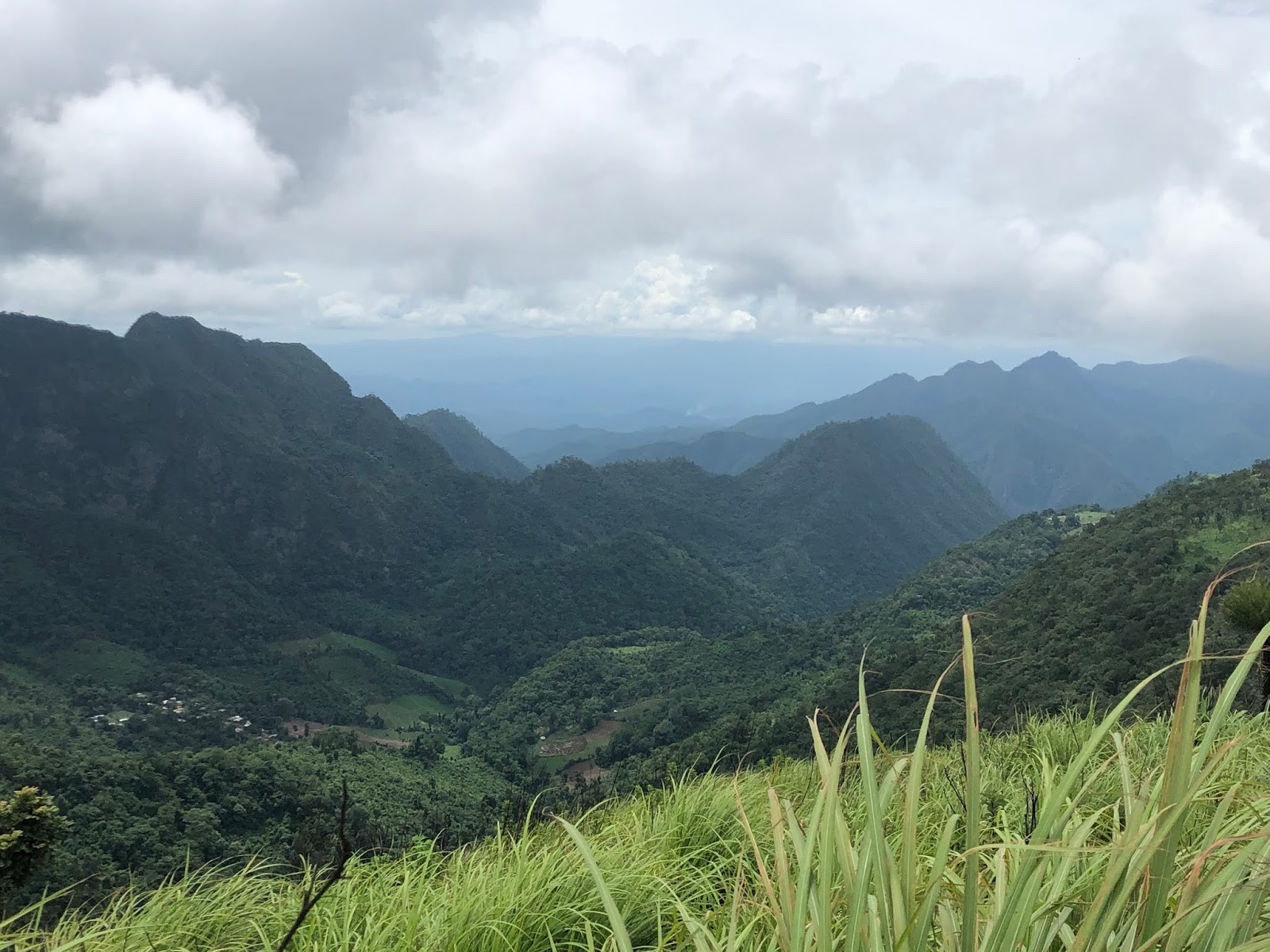
View from Microwave Mountain
Cultural communication/expectations – Part of the waiting was definitely entangled up in communication and cultural issues. Though I had been communicating about my intended plowing goals and everyone knew that was my intent, it came as a bit of a surprise when the large tractor showed up and had the fields plowed in a matter of hours. In the long run, this was fine. I am grateful I didn’t do as much physical labor as I thought I was going to do because I would have died. The days I did work exhausted me.

Thailand has a word/phrase ‘greng jai’ that doesn’t’ translate that well into English but it’s about not wanting to impose on someone or cause anyone to lose face so you might do things you don’t want to do, or give answers that, well, aren’t true, in order to not offend. If I asked someone if I could go with him somewhere and I understood that we were leaving at a certain time, and when he didn’t show up at the appointed time, perhaps he forgot or perhaps he never had any intention me going with him in the first place…but couldn’t say no to my face. I wonder how much this played out with the rice plowing as well as a few other times.

There were also some other hilarious moments when things were said that I was very reluctant to broadcast to everyone within earshot…for example, once I had an upset stomach. Everyone (and I mean everyone) wanted to know how many times I had gone to the bathroom. That’s how they tell how sick you are – sort of makes sense, but again, we (or maybe it’s me) have a lot more shame around telling people how many times we have had diarrhea! There were other body issues that were talked about very matter of factly, and I was desperately wishing I wasn’t present!
There were cultural/language phrases that I could never bridge. I often told one friend that she literally knew everyone in the province as there was never anywhere we went that she didn’t know someone. My point was, she knew a lot of people. She would always reply ‘But I’m from here’ as if that was her excuse. I would think, yes, I know you’re from here, and you still know so many people…and I don’t have good enough Thai to explain the nuance!

While I was in Pa Tyng, I stayed in Aunty Yui’s ‘Garden’ house with her son Golf. Sometimes Golf was gone for the night and I would be there by myself. One night  someone was rummaging around underneath the house and I was a little concerned (not as concerned as the one night that I did think someone was breaking in through my bamboo bedroom wall but it just proved to be a very loud tukgae lizard beating it’s tail against my wall and thrashing around) so I mentioned it to Aunty Yui and Golf the next day. I assumed it was their hired hand who helped with the fields but wasn’t sure. Turns out it was and so they asked him if he comes late at night in the future to call out and let me know it was him. The next day he came pedaling up to the house at noon on his bright pink bicycle whistling really loudly to announce his presence! Some things get lost in translation even among those who speak the same language!


Many in Thailand (perhaps most) still believe that you get sick if you get caught in the rain – not that your germy kids have anything to do with it. Beliefs run deep, which sometimes drove me a little bonkers but I can’t judge – how many of us grew up believing that we had to wait an hour after eating before we could go swimming?

And then there were moments that I was grateful for a culture and tradition different than me. It’s very Thai to ask if you have eaten yet and what did you eat? I had one friend would often interrupt a conversation with me by asking if I had eaten yet. She wasn’t thinking of the H.A.L.T acronym I often use with clients (if you are hungry, angry, lonely, tired take care of yourself…) but it served the same purpose, interrupting my stress or anxiety of the moment. I also had two friends who often told me ‘don’t think too much’ as they viewed that as causing myself undue stress. I often didn’t have to say anything was troubling me. One evening when I was having a lot of thoughts and stressed about something, but I thought I was hiding it pretty well, one of my friends took a glance at me and said ‘don’t think so much…have you eaten yet?’ OK, point taken. Thank you.

But sometimes the cultural expectations were challenging. I love rice a lot and am happy to eat it a lot – even three times a day - but every now and then I wanted a break from it and this caused some challenges as everyone knows that rice is the ONLY thing that will fill you up in Thailand. If you haven’t had rice, you haven’t eaten. I could share more stories here but let’s say sometimes there were duplicitous ways of getting around this belief!


Being rooted - I scribbled this down on a scrap of paper one day…’I believe in knowing a place as well as you can, staying rooted – even as I travel, I want a home base but I also want to know where I am when I’m there – looking for anchors and touch points – thus, that’s why I just enjoy sitting in their living area and looking at the view and watching the two weaver birds fly back and forth with long grass building their nests…how the brilliant flame of the forest flowers are dropping as everything else continues to become more lush and green.’

Speaking of knowing a place and being rooted, I was surprised that when I arrived in Maehongson, I wasn’t giddy with excitement at the opportunity of being there for the longest stretch of time in two decades. I was certainly happy and grateful to be there but I didn’t have the level of excitement that I thought I would have - and that I have experienced on previous trips. Maybe it is because over the last ten years, I’ve been fortunate enough to be able to visit five or six times. I realized that is how my village neighbors view me. When I initially arrived I was walking down the village path and someone passed me on their bike and said ‘Oh Duncan, when did you arrive…have you eaten yet?’ and then kept going. It just felt very normal for me to be there and clearly was normal to this person that wasn’t surprised at all to see me back.

Maehongson
The actual field work – As I was plowing with Uncle Yurn, Tori Kelly’s cover of Seal’s Crazy was in my head… ‘In a world full of people only some want to fly, isn’t that crazy?’ That may be a good theme for this whole endeavor. How many people take a break mid career to follow a dream or do something that doesn’t quite fit the mold we have been taught. Not many.


I was also struck by how the times have changed as society switches from a largely agriculture based economy to a modern cash based one. Twenty years ago farming was still a family affair. Everyone chipped in. When it came to busy times, extended family and friends would show up for the transplanting or harvest. Now the children have moved to cities or if they are still around are working in Maehongson at the Toyota dealership or regular cash paying jobs. That means the work of pulling up the rice seedlings and transplanting the rice is done by hired hands - often immigrants or refugees.  I was shocked when I went out to observe the transplanting that I knew none of the women doing the work. This of course mirrors what we have experienced in the West when it comes to farming/agriculture but to see it happen so rapidly is jarring. 

Adventures  (River deep, Mountain high?) - If I spent the first month waiting, my last month was jam packed not only with rice growing field preparation but many adventures with family and friends. This deserves it’s own post. Stay tuned!


View from Doi Kong Mu

Wat Phra That Doi Kong Mu

View of Pabong Dam

View from Microwave Mountain


Duncan

Tuesday, August 27, 2019

Kabul

I didn't know what to expect when I arrived in Kabul. It's technically still a war zone. American's are flown by helicopter from the airport to the US embassy compound inside the green zone. My flight  from Dubai to to Kabul was remarkably empty, with no kids or families. That seemed to confirm that my latest work destination was going to be a little different. BUT, my return flight a week later was packed full of families and children leaving a very very different impression - one that I was happy to take with me. It felt like Disneyland - and apparently that is what most flights in and out of Kabul are like. I think my first flight was on a religious day where few were travelling. As usual, I can't share that much of my work. I couldn't take any photos once I was there but I got a few as we flew in to this capital city that sits at about 6000 feet elevation surrounded by stark mountains. Here are a few thoughts...


I arrived in Kabul the evening of the recent wedding attack that killed over eighty people, injuring hundreds more. (Weddings in Afghanistan are huge celebrations with hundreds to over a thousand attending.) This attack lingered throughout the week as a backdrop to my time and an illustration of the challenges that so many face in a country that the US is still technically fighting a war. Insecurity and attacks of all sorts are still common and the threat to those that work for Western organizations is extremely high. 

Those I was with this past week risk their lives every day to go to work to help build a more peaceful and stable Afghanistan. They don't know if they will return at night to see their children and their families. Their stories of trauma and grief are only rivaled by their courage to keep showing up. The morning after the wedding attack, everyone was at work. I told them that if a suicide bomber killed eighty people in Washington DC, people wouldn't return to work for weeks. It would take years for us to recover. Every time I led a session on stress and resilience I said that my local Afghan colleagues should be leading it. They know something about resilience and thriving that most of us will never know. Their fortitude is sustained by faith and by family, the bedrock of their society. 

The memories and backdrop of the wedding attack will linger as another layer of trauma for them and a difficult memory for me but what I will remember about my very short week in Afghanistan are the beautiful stark mountains that surround Kabul, the roses and beautiful flowers  in the compound I stayed that the local gardeners take so much pride in, the beautiful green farm land outside of Kabul that I saw photos of...I will remember the anguish and struggle so many face over the opportunity to leave for a new home that offers the opportunity of safety and peace or to remain with family in Afghanistan, continuing to build a more peaceful country, but at the risk of their life and their family. But mostly I will remember the faces of those who have experienced such great tragedy and loss - loss that I will never understand - and yet they choose to continue living, refusing, as Rumi writes, to be a 'caravan of despair.' I will remember their stories of great sadness as well as those of great courage, strength and beauty. 

Duncan

PS The Sewing Circles of Herat by Christina Lamb is a great book that will give you much insight into Afghanistan.


Wednesday, August 14, 2019

Rice Growing - From field preparation to transplanting.


This blog post is really just to show and describe the rice growing process without too much 'commentary' about my experience and observation from me. I'm saving that for a future post. 

In some places in Thailand, farmers can do two rice growing seasons. In Maehongson, it's usually limited to one cycle that coincides with the rainy season. Each farmer begins preparation of their fields based on their specific location, weather patterns and when their is enough water in the rivers that feed the 'nam hong' (water canal) that brings the water to flood the paddy fields. (Hill rice is also grown here - as it's name implies on hills (often slash and burned) and this requires no flooding. That's not the rice I'm doing.) 

I arrived in Maehongson and specifically back in the village of Patyng (where my parents lived for eight years) the second week of June in preparation for working in the fields. The plan was that I would help our former landlord's family in their fields. Golf is the 30 year old son of our former landlord and I would be helping him. 

Golf's great grand parents used to own the entire plot of fields seen below. At some  point two sections were sold off. The lighter green fields are split between Golf's family and a cousin.


Rice growing begins with the initial seed bed preparation. The rice is soaked over night and then scattered where it sprouts and grows for four to six weeks. The rice was already sprouting by the time I arrived in early June.


While the seedlings are growing, the rest of the fields are usually flooded, plowed and harrowed into liquified mud ready for the rice to be transplanted in. Before mechanized times, water buffalo and oxen were used only to be replaced by large oversize roto tillers. Both options are long, hard, exhausting work which can take up to two weeks.


Astute followers of photos that have been posted here or on facebook may have noticed a picture with a tractor in the background...let's just say times they are a changing. I kept asking when plowing would begin and I didn't really get a straight answer. All of a sudden after I had been 'waiting' for several weeks, a guy on a tractor appeared and for the princely sum of 800 baht ($25) an hour the fields were completely plowed in about four hours. Done. And I wondered, ok, well clearly that alters my plans a little as I thought I would be able to do a little plowing! I certainly don't begrudge this decision though. Who wouldn't choose to spend that money to save so much time and physical energy?

This is the first time Aunty Yui(and perhaps anyone in this village) has rented a tractor to do this - and honestly it's surprising it hadn't happened before. At the time I thought that everyone with the right sized fields would quickly switch to doing it this way - but as it turned out, I'm not sure that they will do it this way again. The tractor simply didn't plow the soil deep enough. Perhaps if that can be adjusted they will use the tractor again but if not, it's back to the hard laborious work of using the 'roto- tiller.' 


The tractor was a novel sight - many people quickly appeared to observe.

Aunty Yui - overseeing the tractor. 


And just like that the fields were plowed!
Normally if doing it the old way, the fields would have been flooded prior to the plowing. Using the large tractor, the fields were plowed and then the water was allowed to flow into the fields and flood them. But for about a week there were some issues with not enough water coming through the nam hong to adequately submerge everything, allowing all the grass and weeds to rot. 


Eventually the water was flowing sufficiently
I knew I would still have the opportunity to work with the roto tiller as the fields  can't be harrowed using the tractor. But I really wanted to do some actual field preparation and plowing. I eventually found it in the fields of Uncle Yurn where I spent time helping to cut the long grass and weeks and eventually a day plowing. I wrote on facebook that 'Uncle Yurn doesn’t really look like Mick Jagger but there’s something very Jaggerish about him when he screams past me in his motorcycle with side car or when he’s dressed to do field work - maybe it’s his sun glasses or maybe just his attitude. It’s like he doesn’t care what anyone thinks! Anyway, he has been gracious enough to take me under his wing so to speak when other options have fallen through - though he’s also fully used me to work - which I wanted- no babying here. He makes it look easy - plowing with grace and ease, perhaps like Jagger dances. I on the other hand initially was plowing like a water buffalo doing ballet. Fortunately by the third or fourth field I had a better hang of it and was letting the ‘beast’ do the work. And Uncle Yurn trusted me enough to go off and do other things. But my hands are blistered, cut and mangled, my shoulder sockets feel like they have been torn apart and I can barely walk. All in all a good day! Fortunately Uncle Yurn’s wife is the village masseuse - I will be visiting her tomorrow! No picks of me plowing - Jagger doesn’t take pics, he’s in them. But the proof is my dirty self!'


Tuesday, June 25, 2019

Right Place, Right Time

 Enjoy these two short videos. The first occurred during my two days in Chiang Mai as I wandered and went on a walk about. I had made it to Wat Chedi Luang and for whatever reason the usual entrance had a sign telling foreigners go to another entrance. Maybe that sign is always there but like the 'good try not to be offensive and follow the rules' traveler that I am, I followed directions and ended up walking all around the complex, ending right back up where I started 30 minutes earlier but now dripping even more with sweat. So then I just went in the entrance I should have gone in the first time around.

This photo looks like someone did a rough edit or a David Copperfield magic trick to make the top portion disappear but that's what it looks like.

Another view with the new King and Queen

Right as I walked in they were moving the Buddha statue to another temple and I was able to capture what you see in the video which was kind of cool and quintessential North Thailand. And had I not taken the long route, I would have missed it. So while I am on this journey, I am grateful for this early reminder to embrace each day that doesn't seem to go the way I want because I don't know what I might experience as a result. And it has been a good lesson given the relative lack of rice growing I have done so far!


The second video is just me and a friend - also involving a walk about. It's titled Pig Escape 2 because last time I was with Pi Toi and Pi Lee, this one's mother also escaped and unlike her daughter, she did not go willingly back into her pen. Many bananas were required. Again, just happened to be at the right place at the right time. Enjoy!


Duncan

Friday, June 21, 2019

Now about that rice...Update 1


So you may be thinking...ok, Duncan, you've been in Thailand three weeks, when does the rice growing begin? Good question. It actually has begun. In some places in Thailand, farmers can do two rice growing seasons. Here in Maehongson, it's limited to one that coincides with the rainy season. Each farmer begins preparation of their fields based on their specific location, weather patterns and when their is enough water in the rivers that feed the 'nam hong' (water canal) that brings the water to flood the paddy fields. (Hill rice is also grown here - as it's name implies on hills (often slash and burned) and this requires no flooding. That's not the rice I'm doing.)

Rice growing begins with the initial seed bed preparation. The rice is soaked over night and then scattered where is sprouts and grows for four to six weeks (so I am told.) This had already happened by the time I got here.
Golf and his cousin's seed beds - the hill behind is where I take all the village pictures from. 
While it's growing, the rest of the fields are usually flooded, plowed and harrowed into liquified mud ready for the rice to be transplanted in. Before mechanized times, water buffalo and oxen were used only to be replaced by large oversize roto tillers. Both options long, hard, exhausting work which could take up to two weeks.

Starting up the beast...
Astute followers of photos that have been posted here or on facebook may have noticed a picture with a tractor in the background...let's just say times they are a changing. I kept asking when plowing would begin and I didn't really get a straight answer. All of a sudden last Saturday, a guy on a tractor appeared and for the princely sum of 800 baht ($25) an hour the fields were completely plowed in about 3-4 hours. Done. And I wondered, ok, well clearly that alters my plans a little as I thought I would be able to do a little plowing! I certainly don't begrudge this decision though. Who wouldn't choose to spend that money to save so much time and physical energy?


This is the first time Ba Youie (and perhaps anyone in this village) has rented a tractor to do this - and honestly it's surprising it hadn't happened before. I'm sure everyone will quickly switch to doing it this way and if they can't afford the cash payment, they can pay by promising a portion of the rice that is harvested.

Now the fields will be flooded to allow all the grass and weeds to rot. The good news (for me) is that the fields can't be harrowed using the tractor so I will still get some roto tiller time in the coming days. And there are enough other people still plowing the 'old' way - I'm sure I can find someone who will let me make a fool of myself!

Golf's great grand parents used to own the entire plot of fields seen here. At some  point two sections were sold off. The plowed fields below are split between Golf's family and a cousin.


Duncan

Where and Who...

If you are new to the Wilson's Wanderings here are two blog posts I wrote ten years ago that describe where I am physically. They still paint a good picture even ten years later...read them here and here.

On the map, here's the lay of the land...

Blue dot, 10 km south of the provincial town of Mae Hong Son is Pa Tyng where my parents moved when I was in 8th grade. Red dot (20km north of MHS) is Naplajat (Fish Fields) where my parents moved while I was in college. These are the two villages I  am staying in while I'm here. A few miles north of Naplajat or west of Pa Tyng and you'll quickly find yourself on the border with Burma. If you're read the 'Thoughts on a 90km stretch of road' blog referenced above, the 90 km stretches from Naplajat south to a little village just outside of Khun Yuam at the bottom of the photo above.
Pa Tyng
Naplajat - harder to capture a photo of the entire village (this photo taken several years ago)


Rain rolling in...


I've posted the view from the front porch in Pa Tyng where I am staying in the garden house of Ba Youie with her son Golf (and wife Nam Waan when she comes home on the weekends from teaching in another village an hour away). The three photos above are of the rain rolling in over the hills which I love to just sit and watch. I had always thought I would do this rice thing with Ba Youie's husband Loong Douie (Golf's dad) but he was tragically killed in a motorcycle accident last year. That partly spurred this endeavor to happen sooner rather than later. 

Ba Youie, Naam Waan and Golf...and a pineapple...

...and here's my morning view from the porch of Pi Toi and Pi Lee's house in Naplajat when I stay there which hosts visitors and village friends on a continual basis.

Pi Lee has a portable rice mill which is pretty cool!
Both houses where I am staying have experienced recent loss. Loong Douie died just over a year ago and in Naplajat, Grandfather Naan, Pi Toi's Father just passed away two months ago. This past Sunday about 100 people from the village and surround area came to remember him.


Pi Toi at her dad's grave/memorial site

This is where I am and the people I'm with. 

Duncan